
my thoughts on the hobbit
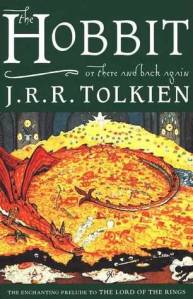
I should probably preface this by stating that one of my assignments for my Children’s/Young Adult literature class when I was taking courses at the University of Maine was that each week, we read a book from an assigned genre, and were required to write an annotation. My choice for fantasy/fiction was J.R.R. Tolkien’s The Hobbit. and though I am ashamed to admit it, it was my FIRST TIME EVER reading this novel. This year, I decided to listen to the audiobook and I was not disappointed. I feel like the annotation I did back in 2013 still holds true here in 2020.
Tolkien, J.R.R. (1937, 2002) The Hobbit or There and Back Again Boston: Houghton Mifflin A prequel to The Lord of the Rings trilogy, Tolkien’s The Hobbit, gives the reader insight to the world of Middle Earth, as well as the year of adventures for Bilbo Baggins. A hobbit who lives in the neighborhood of The Hills, Bilbo Baggins’ life of comfort and solitude is greatly shaken when he receives a visit from the wizard Gandalf who prompts him to join in a quest with a herd of dwarves as a “burglar”. Traveling across Middle Earth in an attempt to gain back the dwarves riches–which results in various scraps with goblins, spiders, wolves, an encounter with a dragon named Smaug the Magnificent, and being witness to the Battle of the Five Armies–Bilbo finds himself enjoying an adventure that he never even dreamed was possible for him to experience. This leads into possibly the strongest and over-occurring theme that presents itself within the novel: overcoming the limits that race/lineage place on an individual’s choices in life, and using that strength to induce heroic acts. Though Bilbo himself does not recognize it, in the beginning of the novel we see the development of the hobbit’s interest in adventure and eagerness to show his bravery. This is made known quite early on in the novel, when we learn of Bilbo’s lineage–a constant struggle between his timid Baggins side and his adventurous Took side. A classic novel, The Hobbit also presents itself as a tool that young adults can use in analyzation as well as an enjoyable read. Aside from creating prominent themes and entertaining characters, Tolkien also uses intensifying imagery to bring to life the geography of Middle Earth, and have the reader feel as though this is a realistic place. This literary process of making the story more realistic geographically, is also used to make the story relatable emotionally. While this is a world of fantasy, the emotions evoked throughout this novel–embracing one’s fears and overcoming them through many an opportunity–open the young adult reader’s eyes; giving solace in knowing that whether real or imaginary, those emotions exist and can be used to one’s benefit in life.
 eat. read. write.